Fitness does not have to mean spending hours in the gym or following a complicated workout plan. In reality, building a healthy lifestyle can start with a few simple exercises that you can do consistently every day. The most important part of fitness is not doing a difficult workout once in a while—it is making movement a regular habit.
If you want to become fitter, stronger, more active, and healthier, start small. Just 20–30 minutes of daily exercise can make a meaningful difference when combined with good nutrition, proper sleep, and consistency.
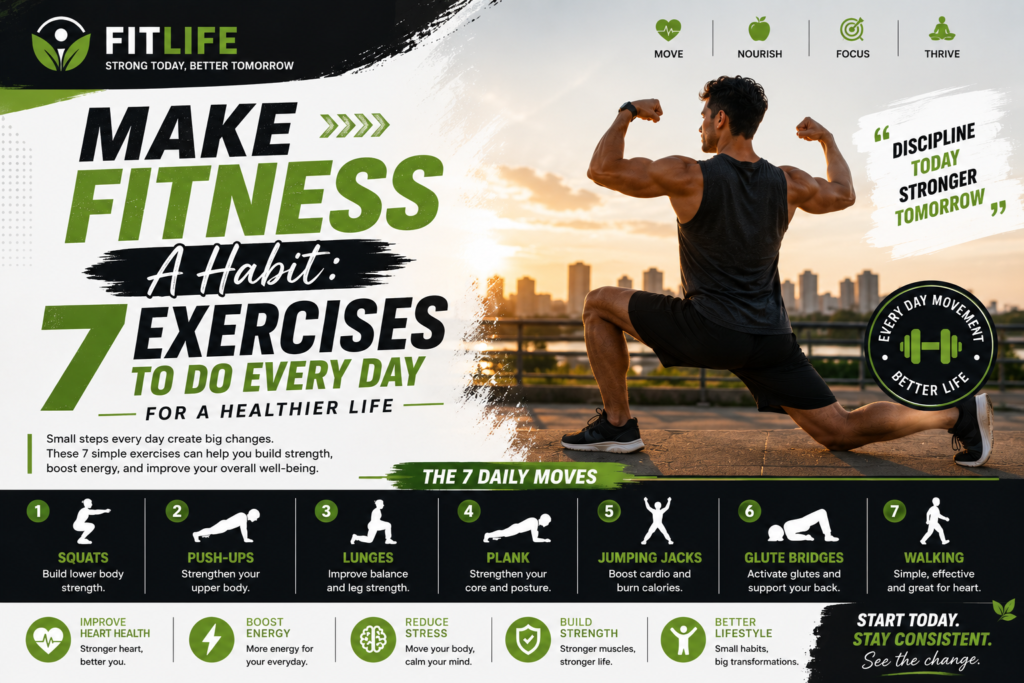
In this blog, we will discuss 7 simple exercises to do every day and explain how you can turn exercise into a long-term fitness habit.
Why Should You Make Fitness a Habit?
Many people start exercising with a lot of motivation but stop after a few weeks. The problem is often not the workout itself but the lack of consistency.
When fitness becomes a habit, you do not need to depend on motivation every day. Exercise becomes part of your routine, just like brushing your teeth, taking a shower, or having breakfast.
Regular physical activity can help support:
- Better cardiovascular health
- Stronger muscles and bones
- Improved flexibility and mobility
- Better posture
- Healthy body weight
- Improved mood and energy
- Better sleep
- Reduced everyday stress
- Greater physical endurance
The goal should not be to become perfect. The goal is to keep moving consistently.
7 Exercises to Do Every Day
You do not need expensive gym equipment to get started. These seven exercises can be performed at home and can be adjusted according to your fitness level.
1. Squats
Squats are one of the most useful bodyweight exercises for strengthening the lower body. They primarily work your thighs, glutes, and hips while also engaging your core.
How to Do a Squat
- Stand with your feet approximately shoulder-width apart.
- Keep your chest upright and your back neutral.
- Extend your arms forward or keep them comfortably by your sides.
- Bend your knees and push your hips backward as if you are sitting on a chair.
- Lower yourself as far as comfortable while maintaining good form.
- Push through your feet to return to the starting position.
Beginner Recommendation
Start with 10–15 repetitions for 2 sets.
As you become stronger, you can gradually increase the repetitions or add resistance.
Why Squats Matter
Squats can help develop lower-body strength and make everyday movements such as climbing stairs, standing up, and walking easier.
2. Push-Ups
Push-ups are a classic bodyweight exercise that works the chest, shoulders, triceps, and core.
You do not need dumbbells or machines to perform them, making push-ups an excellent exercise for a home workout.
How to Do a Push-Up
- Start in a plank position with your hands slightly wider than your shoulders.
- Keep your body in a relatively straight line from your head to your heels.
- Tighten your core.
- Bend your elbows and slowly lower your chest toward the floor.
- Push through your hands to return to the starting position.
Beginner Modification
If standard push-ups are difficult, start with wall push-ups or knee push-ups.
Beginner Recommendation
Try 5–10 repetitions for 2 sets, depending on your current strength.
Why Push-Ups Matter
Push-ups help build upper-body strength and also require your core to stabilize your body.
3. Lunges
Lunges are another effective lower-body exercise. They can help strengthen the legs and improve balance and coordination.
How to Do a Basic Lunge
- Stand upright with your feet together.
- Step one foot forward.
- Bend both knees while lowering your body.
- Keep your front knee controlled and your torso upright.
- Push through the front foot to return to the starting position.
- Repeat with the opposite leg.
Beginner Recommendation
Start with 8–10 repetitions per leg for 2 sets.
If traditional lunges feel uncomfortable, you can begin with assisted or stationary lunges.
Why Lunges Matter
Lunges train each leg individually, which can help improve balance, coordination, and lower-body strength.
4. Plank
The plank is a simple exercise that focuses heavily on your core. A strong core supports many everyday movements and can contribute to better stability and posture.
How to Do a Plank
- Place your forearms on the floor.
- Extend your legs behind you.
- Keep your body aligned from your head to your heels.
- Engage your abdominal muscles.
- Avoid letting your hips drop or rise excessively.
- Hold the position while breathing normally.
Beginner Recommendation
Start with 15–30 seconds for 2 sets.
Gradually increase the duration as your core becomes stronger.
Why Planks Matter
Planks train the muscles responsible for stabilizing your trunk. They are also easy to perform at home because they require no equipment.
5. Jumping Jacks
If you want to add some cardio to your routine, jumping jacks are a simple option.
They increase your heart rate and involve movement of both the upper and lower body.
How to Do Jumping Jacks
- Stand upright with your feet together.
- Keep your arms by your sides.
- Jump while moving your feet outward.
- At the same time, raise your arms overhead.
- Jump back to the starting position.
- Repeat at a comfortable pace.
Beginner Recommendation
Try 20–30 repetitions for 2 sets.
If jumping is uncomfortable, perform a low-impact version by stepping one foot out at a time instead.
Why Jumping Jacks Matter
They can add cardiovascular activity to a short workout and help you feel more energetic.
6. Glute Bridges
Glute bridges are a beginner-friendly exercise that targets the glutes and also involves the hips and core.
How to Do a Glute Bridge
- Lie on your back.
- Bend your knees and place your feet flat on the floor.
- Keep your arms beside your body.
- Tighten your core and glutes.
- Lift your hips toward the ceiling.
- Pause briefly at the top.
- Slowly lower your hips back down.
Beginner Recommendation
Perform 12–15 repetitions for 2 sets.
Why Glute Bridges Matter
Glute bridges can help strengthen the muscles around the hips and lower body. They are also useful for people who want a low-impact exercise option.
7. Walking
Exercise does not always have to be intense. Walking is one of the simplest ways to increase your daily physical activity.
You can walk outdoors, around your neighborhood, on a treadmill, or even take short walking breaks during the day.
How to Make Walking Part of Your Routine
Try to:
- Take a short walk after meals.
- Walk instead of using a vehicle for very short distances when practical.
- Take the stairs when appropriate.
- Walk while talking on the phone.
- Take short movement breaks during long periods of sitting.
You can start with 15–20 minutes of walking and gradually increase the duration.
Why Walking Matters
Regular walking can support cardiovascular fitness, mobility, and overall daily activity. It is also an easy exercise to maintain over the long term.
Simple 20–30 Minute Daily Workout
You do not need to spend an hour exercising. A simple routine can be enough to get started.
Warm-Up – 5 Minutes
Before exercising, spend a few minutes warming up.
Try:
- Arm circles
- Shoulder rolls
- Gentle marching
- Hip rotations
- Light walking
Main Workout
| Exercise | Beginner Target |
|---|---|
| Squats | 10–15 reps × 2 |
| Push-ups | 5–10 reps × 2 |
| Lunges | 8–10 each leg × 2 |
| Plank | 15–30 sec × 2 |
| Jumping jacks | 20–30 reps × 2 |
| Glute bridges | 12–15 reps × 2 |
| Walking | 15–20 minutes |
You do not have to complete everything at maximum intensity. Focus on good technique and consistency.
How to Make Fitness a Daily Habit
Knowing which exercises to do is only half the process. The bigger challenge is doing them consistently.
Here are some practical ways to make fitness part of your lifestyle.
1. Start Small
Do not begin with an extremely difficult workout.
If you have not exercised regularly, even 10–15 minutes a day can be a good starting point.
Once exercise becomes routine, you can gradually increase the duration and intensity.
2. Choose a Fixed Time
Try to exercise at approximately the same time each day.
For example:
Morning: 6:30–7:00 AM
or
Evening: 5:30–6:00 PM
A fixed schedule makes exercise easier to remember.
3. Do Not Wait for Motivation
Motivation changes from day to day.
Instead of asking, “Do I feel like exercising today?” make exercise part of your schedule.
The goal is to build a routine that continues even when motivation is low.
4. Track Your Progress
Keep a simple record of your workouts.
For example:
Week 1: 10 push-ups
Week 2: 12 push-ups
Week 3: 15 push-ups
Tracking small improvements can keep you motivated.
5. Make Exercise Enjoyable
Fitness should not feel like punishment.
Try activities you actually enjoy, such as:
- Walking
- Cycling
- Dancing
- Swimming
- Sports
- Yoga
- Home workouts
- Gym training
The best exercise program is one you can consistently follow.
Don’t Forget Rest and Recovery
Daily movement does not mean you need to perform a hard workout every day.
Your body needs time to recover, especially after challenging strength workouts.
You can alternate between harder and easier activities.
For example:
Monday: Strength workout
Tuesday: Walking + mobility
Wednesday: Strength workout
Thursday: Walking
Friday: Strength workout
Saturday: Light activity
Sunday: Recovery or easy walking
Rest and recovery are important parts of a sustainable fitness routine.
Nutrition Is Also Important
Exercise is only one part of a healthy lifestyle. Your body also needs adequate nutrition to support energy, recovery, and overall health.
Try to include a variety of:
- Fruits
- Vegetables
- Whole grains
- Protein-rich foods
- Healthy fats
- Dairy or suitable alternatives
- Adequate fluids
Avoid focusing only on calories or appearance. A balanced diet should provide the nutrients your body needs.
Sleep and Fitness Go Together
Good sleep is another important part of a healthy lifestyle.
During sleep, your body gets time to recover from daily activities and exercise.
Try to maintain a consistent sleep schedule and create a relaxing environment before bedtime.
Exercise, nutrition, and sleep work together. Improving one area while completely ignoring the others may make it harder to maintain a healthy routine.
Common Fitness Mistakes to Avoid
When starting a workout routine, many people make a few common mistakes.
Doing Too Much Too Soon
Starting with a very intense workout can leave you extremely sore and make it harder to continue.
Increase your workload gradually.
Ignoring Exercise Technique
Doing more repetitions with poor form is not necessarily better.
Learn the correct movement pattern first and then increase repetitions or resistance.
Comparing Yourself With Others
Everyone starts at a different fitness level.
Focus on your own progress instead of comparing your body, strength, or endurance with someone else’s.
Skipping Warm-Ups
A short warm-up can help prepare your body for movement.
Expecting Instant Results
Fitness takes time.
Strength, endurance, mobility, and body-composition changes generally require consistent effort over weeks and months.